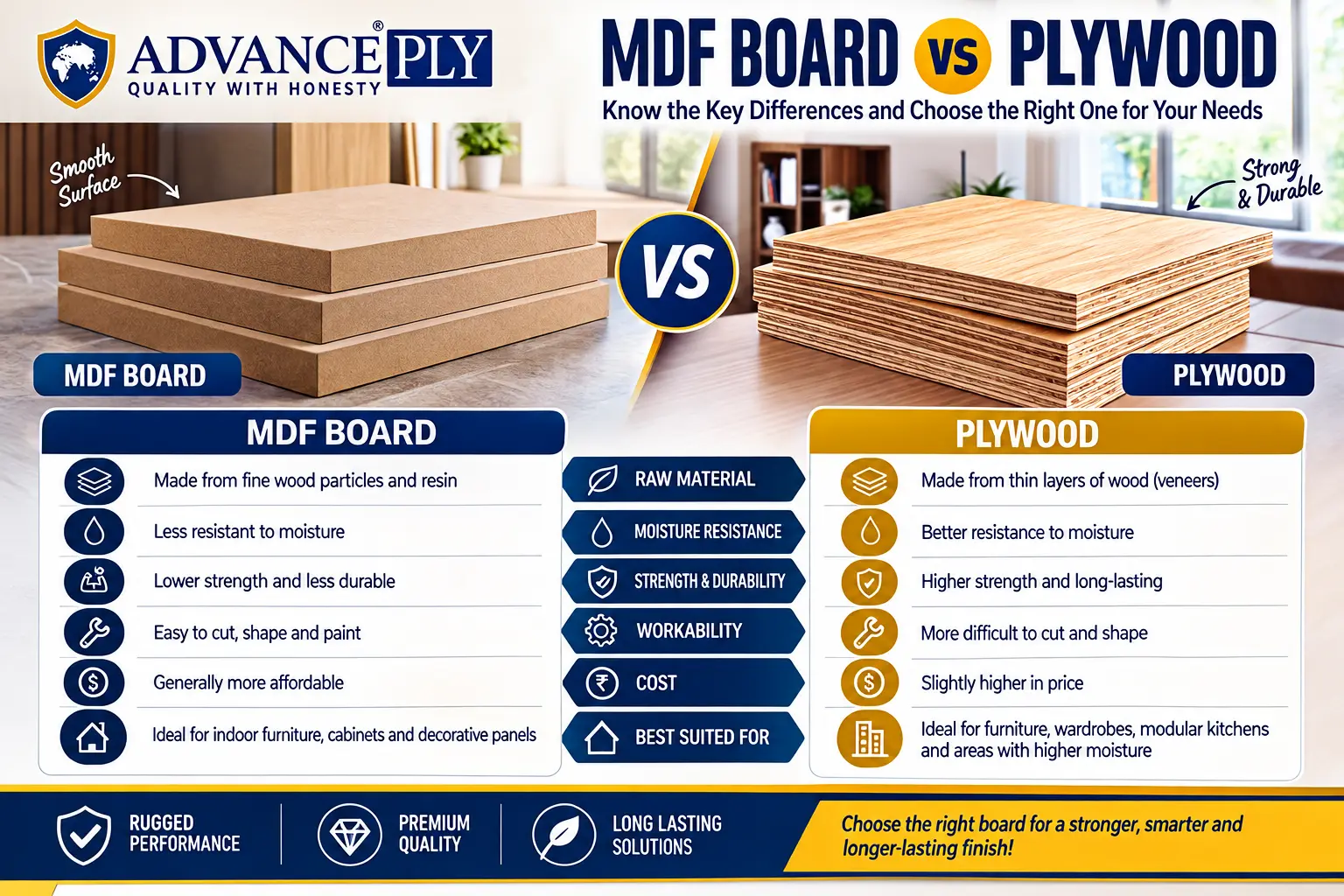
MDF or Plywood, Which Is Better?
Neither is better outright, they fail differently. Plywood is cross-laminated veneer, so it holds screws far better and keeps its shape through damp, which is why carcasses, shutters and anything load-bearing use it. MDF is compressed wood fibre with no grain, so it takes paint and routed profiles beautifully, but it swells permanently once water reaches the core and a screw driven into its edge strips out. Use plywood for structure and wet areas, MDF for painted decorative panels in dry rooms.
Choosing between MDF and plywood decides how a piece of furniture ages. The two are both engineered wood, they are often sold side by side, and they are priced close enough that buyers treat them as interchangeable. They are not. This guide sets out how each one is made, how each behaves under load and under water, and which one belongs in which part of a home.
What is MDF Board?
MDF, or medium density fibreboard, is made by breaking hardwood or softwood residue down into fine fibres. Those fibres are mixed with wax and resin binders, then compressed under heat and pressure into a dense board with a smooth face.
Because MDF has no grain, it cuts, drills and routes without splintering, and the face takes paint without anything telegraphing through. That is what makes it the default for painted shutters, decorative panels and detailed profile work. The same absence of grain is why it holds screws poorly and why it reacts badly to moisture.
What is Plywood?
Plywood is built from thin wood veneers glued together with the grain of each layer turned at a right angle to the one below it. That cross-laminated construction is what gives plywood its strength, its dimensional stability and its resistance to cracking and warping.
Because the grain runs in alternating directions, a screw driven into plywood bites into wood fibre running across the thread rather than along it. That is the single biggest practical difference between the two materials, and it is why plywood is specified for furniture carcasses, doors, flooring and structural work.
MDF vs Plywood: The Differences That Matter
| Basis | MDF Board | Plywood |
|---|---|---|
| Raw Material | Fine wood fibres mixed with resin and wax | Multiple layers of natural wood veneer |
| Manufacturing | Fibres compressed under heat and pressure | Veneers bonded with alternating grain direction |
| Strength | Moderate, not suited to heavy loads | High, from the cross-laminated layers |
| Moisture Resistance | Poor. Swells and the damage does not reverse | Depends on grade. Good in BWR, high in BWP and marine |
| Screw holding, face | Moderate | Strong |
| Screw holding, edge | Poor. The fibre compresses and the screw strips out | Good. The screw bites across the grain |
| Painted finish | Excellent. No grain to show through | Shows grain, so usually laminated or veneered instead |
| Routed and moulded edges | Clean profile, no splintering | Can expose core gaps at the edge |
| Weight | Heavier for the same thickness | Lighter for the same thickness |
| Typical application | Painted shutters, wall panels, decorative furniture | Carcasses, doors, flooring, kitchens, structural work |
| Maintenance | Needs protection from moisture | Low, with good resistance to wear |
What Happens When Each One Gets Wet?
This is the difference that decides most real projects, and it is rarely explained properly.
MDF swells, and the swelling does not reverse: The board is wood fibre compressed under heat and pressure. When water reaches that fibre it expands back out, and once the panel dries the fibre does not return to its compressed thickness. The edge thickens, the face lifts, and the paint or laminate over it cracks. A swollen MDF edge is replaced, not dried out.
Plywood depends entirely on its grade: The veneers stay intact. What is being tested is the glue line between them. An MR board delaminates in sustained damp. A BWR board handles humidity and the occasional spill. A board certified to IS 710 is tested for 72 hours in boiling water and carries preservative treatment as well, which is what protects it over years of exposure rather than hours.
In both materials the edge is the entry point: A cut edge exposes the core directly, which is why unsealed bottom edges on base units fail first in every kitchen and bathroom. Sealing every cut edge with edge banding tape is part of the specification, not a finishing touch.
The practical rule: if a panel can ever meet standing water, specify the right plywood grade and seal the edges. If it will only ever be painted and dry, MDF is the better surface.
Where Each One Actually Belongs?
The comparison above is the theory. This is the decision, by the thing you are actually building.
| Application | Specify | Why |
|---|---|---|
| Wardrobe carcass and shutters | Plywood, 18mm | Carries hanging rails and door weight, and holds hinge screws through years of use |
| Kitchen base units and sink run | Plywood, BWP or marine | Spills and standing humidity. MDF swells permanently once water reaches the core |
| Bathroom vanity | Plywood, IS 710 marine | Continuous humidity, and the preservative treatment matters as much as the bonding |
| Painted shutters in a dry room | MDF | No grain to telegraph through the paint, and a routed profile comes out clean |
| Decorative wall panels, dry areas | MDF | The face finish is the whole point and the panel carries no load |
| Shelves carrying books or crockery | Plywood, 19mm | MDF sags under sustained load across a span |
| Drawer bottoms and back panels | Plywood, 6mm | Thin, light, and carried by the frame rather than by itself |
| Anything within reach of plumbing | Plywood of the right grade | In MDF the failure is irreversible, so there is no recovery from one leak |
Which One Should You Choose, MDF or Plywood?
Pick MDF when the surface is the point and the room is dry. Painted wardrobe shutters, decorative wall panels, routed profile work and anything where a flawless paint finish matters more than load. In those jobs MDF does something plywood cannot do as well.
Pick plywood when the panel carries weight, takes a fixing, or could ever get wet. Carcasses, shelves, doors, kitchen and bathroom units, and anything that has to hold a hinge screw for a decade. Match the grade to the exposure as well as the material, because an 18mm MR board under a kitchen sink fails the same way a 6mm one would, only slower.
Why Choose Advance Ply?
Advance Ply manufactures plywood, block board, flush doors and PVC edge banding, and does not make MDF or laminates. The plywood range runs from MR and BWR grades under IS 303 through to marine boards certified under IS 710, with the test figures published on each product page rather than summarised as a claim. Where a project genuinely needs MDF for painted panel work, buy it from a dedicated MDF manufacturer and keep plywood for the structural parts.
What to Specify, Room by Room
MDF for painted shutters and decorative panels in dry rooms. Plywood for every carcass, every shelf that carries weight, and everything within reach of a water line. Where the two meet, in a painted kitchen shutter for example, MDF is acceptable on the shutter and wrong on the box behind it.
The expensive mistake is not choosing the wrong material. It is choosing the right material and the wrong grade, then sealing none of the edges.
Specifying Plywood for a Room That Gets Damp?
Tell us the room, the furniture and the moisture it will face. We will tell you which Advance Ply board and thickness to specify, and point you to a dealer who stocks it.
Frequently Asked Questions
What is the main difference between MDF and plywood?
Construction. Plywood is built from thin wood veneers glued in alternating grain directions, which is what gives it strength and screw holding. MDF is wood fibre broken down and compressed with resin into a uniform board with no grain at all. That one difference drives almost every other difference between them.
Which is stronger, MDF or plywood?
Plywood, by a wide margin, for anything that carries load or takes a fixing. The cross-grain veneers resist bending and let a screw bite into wood fibre running across the thread. MDF has no grain, so a screw in its edge compresses the fibre and strips out under repeated load.
Is MDF waterproof?
No. MDF absorbs water through the face and far faster through a cut edge, and the swelling is permanent because the compressed fibre cannot return to its original thickness. Even moisture-resistant MDF is made for humidity, not standing water. For a kitchen sink run or a bathroom, specify a marine board under IS 710 instead.
Can you use MDF in a kitchen or bathroom?
Not for the carcass, the base panels or anything near a water line. MDF is reasonable for painted shutters in a dry room and for decorative panels away from plumbing. The parts of a kitchen that actually fail are the sink base and the bottom and back panels, and those need plywood of the right grade.
Why do painters prefer MDF?
Because it has no grain and no voids, so the face takes primer and lacquer without anything telegraphing through, and a routed edge profile comes out clean. Plywood shows its grain and sometimes core gaps at the edge, which is why plywood shutters are usually laminated or veneered rather than painted directly.
Does Advance Ply make MDF?
No. Advance Ply manufactures plywood, block board, flush doors and PVC edge banding, not MDF or laminates. If a project genuinely needs MDF for painted panel work, buy it from a dedicated MDF manufacturer and keep plywood for the structural parts.
Is MDF cheaper than plywood?
MDF generally costs less than plywood of the same thickness. The comparison worth making is over the life of the panel rather than per sheet, because the places where plywood is specified are the places where MDF swells, strips a screw or gets replaced. On a painted panel in a dry room MDF is the better buy. On a carcass or anywhere near water it is not.