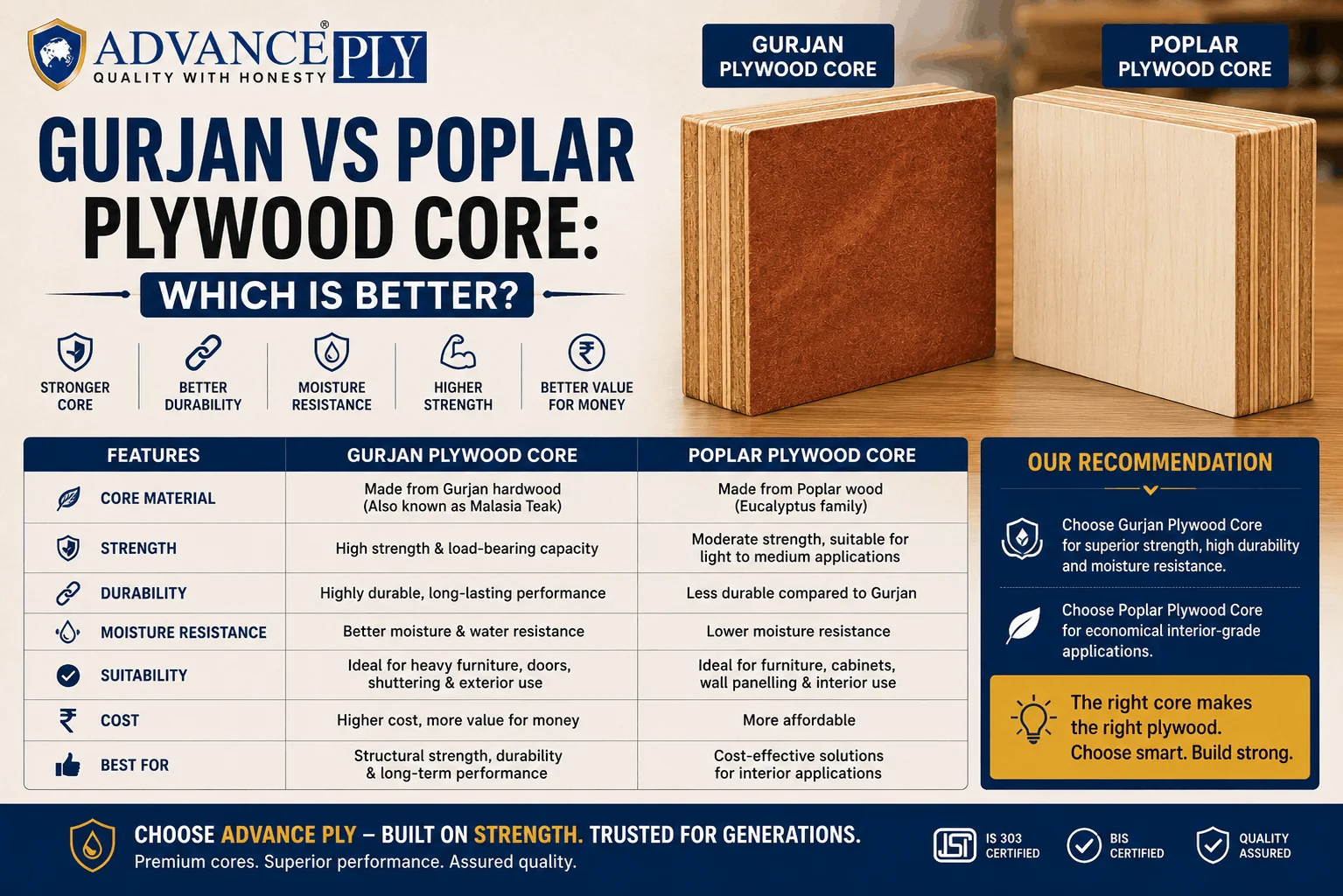
Gurjan vs Poplar Core: Which Is Better?
For furniture that carries load, takes hinges or has to last, Gurjan is the better core; for light, non-structural or budget work, poplar is usually enough. The core is the stack of veneers between the two faces, so it makes up most of the sheet and largely decides how the plywood performs.
- Gurjan is a dense tropical hardwood with excellent screw-holding, natural termite resistance and high durability, and it costs more.
- Poplar is light, soft and cheaper, and machines fast, but holds screws poorly and dents easily.
- Two sheets at the same IS 710 rating can perform very differently depending on the core inside.
- The trap to avoid: "hardwood core" printed on a sticker means nothing until the species is named. Ask the dealer to name it.
What the core actually does?
Two sheets can carry the same IS 710 marking, the same brand and the same price band, and behave completely differently because the marking certifies the glue and water resistance, not what’s inside. The core controls:
- Screw-holding – whether a hinge stays put after a hundred open-close cycles
- Load-bearing – whether a shelf sags
- Impact resistance – whether a knock dents the surface
- Weight – a full-Gurjan sheet is noticeably heavier than a poplar one
- Gap/void resistance – cheaper cores hide internal gaps that collapse under load
Gurjan Vs Poplar, Side By Side
| Property | Gurjan (Dipterocarpus) | Poplar |
|---|---|---|
| Density | High | Low |
| Screw-holding | Excellent | Weak |
| Durability | High | Moderate-low |
| Natural termite/borer resistance | Good (with treatment, excellent) | Low |
| Weight | Heavy | Light |
| Workability | Harder to cut | Easy, fast |
| Warp resistance | High | Lower |
| Price | Premium | Economical |
| Best for | Kitchens, wardrobes, load furniture, doors | Back panels, light partitions, budget work |
Where poplar earns its place: it isn’t a “bad” core – it’s a light, inexpensive one. For a back panel, a light partition, or a low-cost rental fit-out, paying a Gurjan premium is wasted money. Match the core to the job.
Eucalyptus and mixed hardwood sit between the two – denser than poplar, cheaper than full Gurjan. A “mixed hardwood core” can be perfectly good or quietly weak depending on the mill, which is exactly why the species question matters.
Full Gurjan Vs Gurjan-Faced
A common upsell trap: “Gurjan plywood” that is only Gurjan on the outer veneers, with a cheaper filler core inside. Full-Gurjan (or high-Gurjan-content) construction performs very differently from a Gurjan-faced board with a poplar or softwood filler. Ask specifically: is the core Gurjan throughout, or only the face?
How to check what you’re actually buying?
- Ask the dealer to name the core species not “hardwood,” the actual species. Hesitation is an answer.
- Lift the sheet. Gurjan is visibly heavier than poplar of the same size and thickness.
- Inspect the edge. Look for tight, even veneers with no visible gaps or overlaps.
- Do the screw test if the dealer allows: a Gurjan core grips; a soft core strips.
Core quality sits alongside grade (IS 303 vs IS 710) and emission grade as the three things that actually separate one sheet from another. For how the leading manufacturers handle core and certification, see top plywood brands in India.
Frequently Asked Questions
Is Gurjan core plywood worth the extra cost?
Yes, for anything load-bearing, hinged or meant to last, such as wardrobes, kitchens, doors and shelves. Gurjan’s better screw-holding and durability pay back over the furniture’s life. For back panels and light non-structural parts, poplar is the sensible economy, so match the core to the job rather than paying a premium everywhere.
What does "hardwood core" mean on plywood?
On its own, “hardwood core” tells you very little; it only means the core is not softwood. It does not name the species, and species is what determines strength. Always ask whether the core is Gurjan, eucalyptus or an unspecified mix before you buy.
Is poplar plywood bad?
No, poplar plywood is not bad. It is light, cheap and easy to work, and it is the right choice for non-structural, budget or low-load applications like back panels and light partitions. It only becomes a problem when it is used, or sold, where a dense hardwood core is actually needed.
How can I tell Gurjan from poplar plywood?
Weight is the quickest test: Gurjan is markedly heavier than poplar of the same size and thickness. Also check the edge for dense, tight, even veneers with no gaps, and ask the dealer to name the core species and confirm whether it is full-Gurjan or only face-Gurjan with a cheaper filler inside.