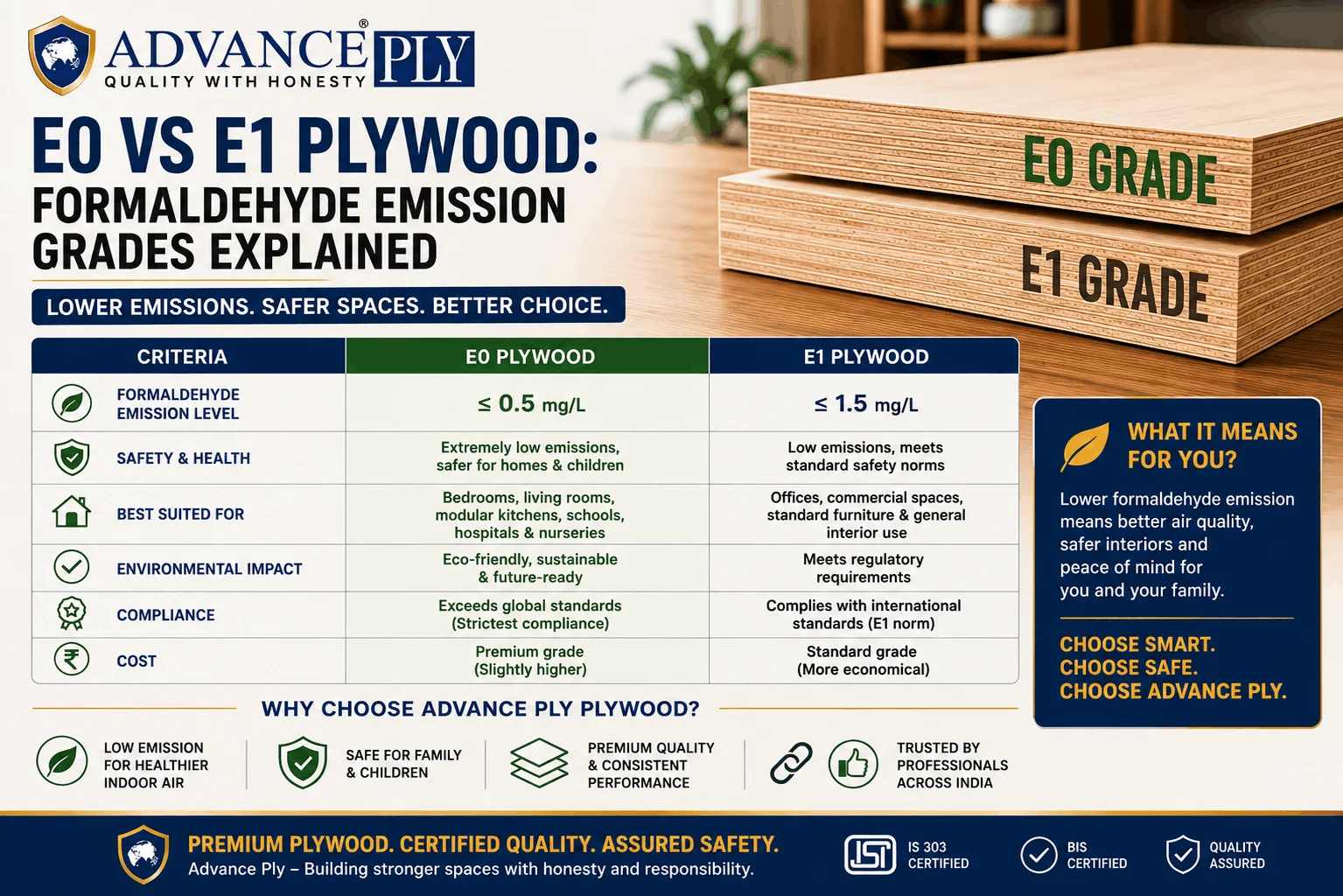
E0 vs E1 Plywood: What Do the Emission Grades Mean?
Plywood is wood bonded with resin, and that resin slowly releases formaldehyde, a recognised indoor-air pollutant, into the room. Emission grades measure how much. For bedrooms, children's rooms, kitchens and green-certified projects, aim for E0; E1 is the minimum you should accept indoors.
- E1 is the widely accepted safe threshold for indoor use (≤ 8 mg/100g by the perforator method, or ≤ 0.124 mg/m³ by chamber test, per European standard EN 13986).
- E2 emits more and is unsuitable for enclosed living spaces.
- E0 is an ultra-low, voluntary grade well below E1.
Where formaldehyde comes from?
Most plywood is bonded with urea-formaldehyde or phenol-formaldehyde resin. Over time and faster in heat and humidity and free formaldehyde off-gasses from the glue lines into the air. The World Health Organization’s cancer research arm classifies formaldehyde as a known human carcinogen, and short-term exposure at higher levels can irritate the eyes, nose and throat.
The risk isn’t uniform. It’s highest where bonded surface area is large and ventilation is low, which describes a fitted wardrobe wall, a full modular kitchen, or a small closed bedroom almost exactly. That’s why emission grade is a health specification, not a marketing badge.
What the grades actually mean?
| Grade | Perforator value (EN 120) | Chamber (EN 717-1) | Suitability |
|---|---|---|---|
| E0 | Ultra-low (voluntary; typically ≤ ~1.5 mg/100g, “Super E0” lower still) | Well below E1 | Best for bedrooms, nurseries, kitchens, green buildings |
| E1 | ≤ 8 mg/100g | ≤ 0.124 mg/m³ | Accepted safe threshold for indoor use |
| E2 | > 8 to ≤ 30 mg/100g | Above E1 | Not for enclosed living spaces |
For reference, other standards you may see on premium or export products: CARB Phase 2 (US) caps hardwood plywood at ≤ 0.05 ppm, and Japan’s F★★★★ (F-four-star) at ≤ 0.3 mg/L is among the strictest grades in the world. A board carrying CARB P2 or F★★★★ is at the low-emission end.
The India-specific point most articles miss
Indian standards measure formaldehyde by the IS 13745 perforator method and the IS/ISO 12460 chamber method, and India’s emission classification broadly follows the European E1/E2 system. Notably, E0 is not a separately codified grade under Indian standards; it’s a voluntary ultra-low designation manufacturers adopt and test to.
The practical consequence: when a brand claims “E0,” ask which test method and which standard the claim is measured against, and ask for the test report. A number with a named method (perforator IS 13745, or a CARB/EN certificate) is verifiable. “E0” with no test reference is just a label.
How to buy low-emission plywood?
- For bedrooms, children’s rooms and kitchens, specify E0 and get the emission grade in writing, on the invoice or the datasheet, not just spoken.
- Ask which product line is E0-rated. A brand’s flagship being E0 does not mean the grade you’re quoted is.
- Look for a third-party test report (CARB Phase 2, or an EN/IS chamber or perforator result).
- For IGBC or LEED projects, low-emission boards contribute to indoor-environmental-quality credits, so keep the certificates for documentation.
Emission grade is one of the three things, alongside core species and BIS grade, that genuinely separate one sheet from another. Several manufacturers now offer E0 lines; for who certifies what, see top plywood brands in India. Advance Ply’s premium grades, including Tungsten, use E0 resin.
Frequently Asked Questions
Is E0 or E1 plywood better?
E0 is better because it emits less formaldehyde than E1. E1 is the accepted safe minimum for indoor use; E0 is the stricter, ultra-low grade preferred for bedrooms, children’s rooms, kitchens and green-certified buildings.
Is plywood safe to use indoors?
Yes, E1 and E0 grade plywood is considered safe for indoor use. The concern is with E2 and unrated boards, especially in enclosed, poorly ventilated rooms with a lot of fitted furniture. Choose E1 grade as a minimum, and E0 where people sleep.
What is E0 plywood?
E0 plywood is an ultra-low formaldehyde emission grade, rated well below the E1 threshold. It is not separately codified in Indian standards, so treat any E0 claim as valid only with a test report naming the method (perforator IS 13745, chamber, or a CARB/EN certificate).
Does emission grade affect strength or water resistance?
No, emission grade only measures formaldehyde release, not strength or water resistance. Strength comes from the core and construction; water resistance comes from the resin and BIS grade (IS 303 versus IS 710). Check all three separately when comparing plywood.