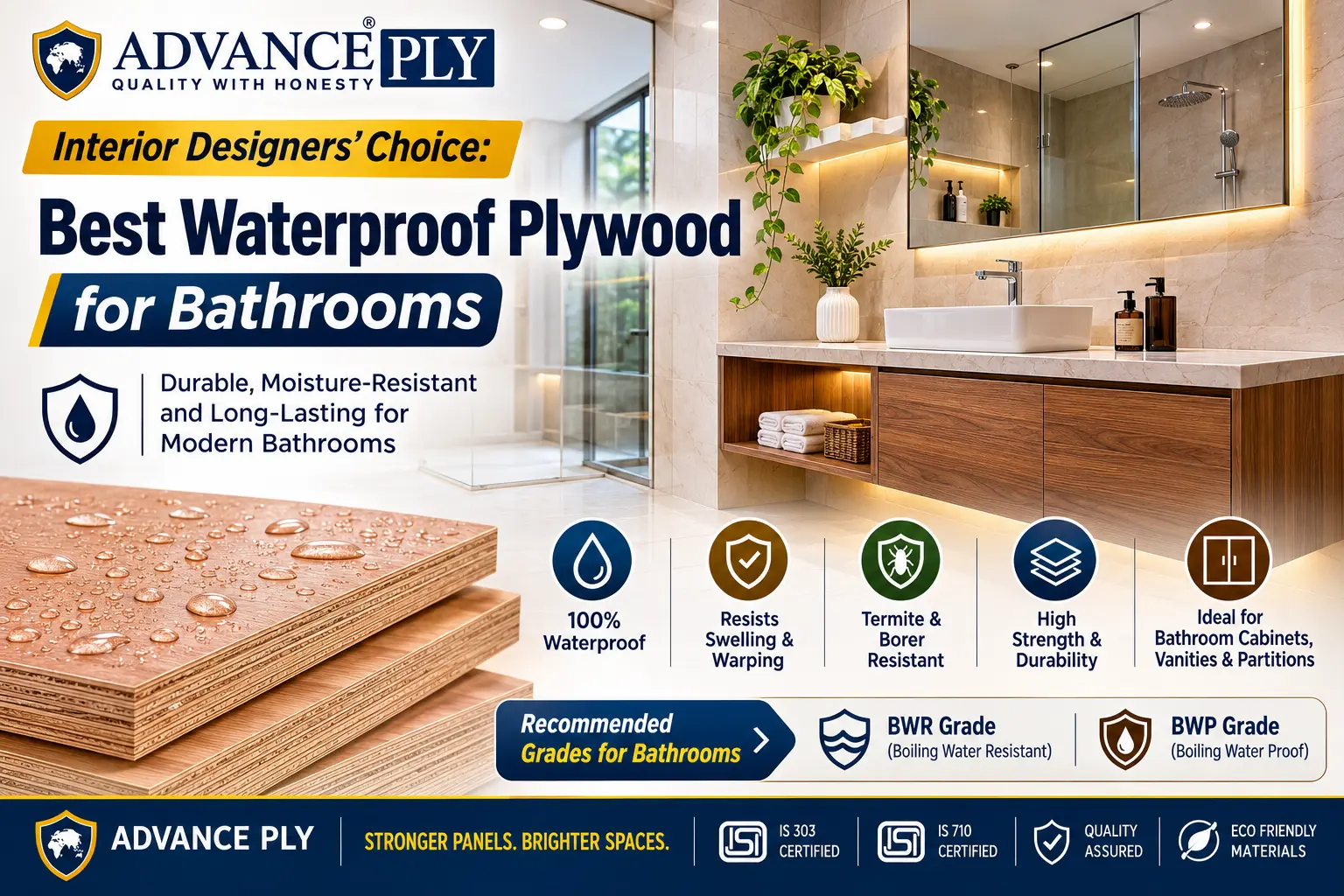
Which Plywood Should I Use in a Bathroom?
A marine board certified to IS 710. A bathroom vanity sits in standing humidity for years, and IS 710 is the only Indian Standard that requires preservative treatment alongside the boiling water test, which is what protects the board against fungi, termites and borers over that exposure. BWR grade under IS 303 is built for occasional damp, not for a wet room. Note also that waterproof is not a term the Indian Standards use at all, so if a board is sold to you as waterproof, ask which standard and which grade is printed on its edge. In the Advance Ply range the IS 710 boards are Tungsten, Palladium and Gold Marine, and the first two carry IS 5509 fire retardant certification as well.
Bathrooms combine constant moisture, humidity and temperature swings, and most furniture failures in them trace back to the board rather than the workmanship. Getting the grade right is the decision that matters, and it is made before anything is cut.
Why Waterproof Plywood is Essential in a Bathroom?
A bathroom is a high moisture environment, and standard plywood deteriorates quickly once water reaches the glue line. The right board gives you:
- Protection against water damage and humidity
- Strength that lasts rather than fades
- Resistance to swelling, warping and cracking
- Durability in cabinets and vanities, where failure is most expensive
- A stable surface for laminates and decorative finishes
Use a board that is not rated for the exposure and you get repeated repairs, surface damage and early replacement.
Why "Waterproof Plywood" Is Not a Standard Grade?
Waterproof is a shop-floor word, not a specification. The Indian Standards do not use it. What they define is how a glue line behaves under boiling water, and whether the board carries preservative treatment. Those are the two things worth asking about.
| Grade | What it means | Water performance |
|---|---|---|
| MR, IS 303 | Moisture resistant. Dry indoor use | Not suitable for boiling water exposure |
| BWR, IS 303 | Boiling water resistant. Interior use with humidity | Withstands up to 8 hours of boiling water |
| BWP, IS 303 | Boiling waterproof. Named grade since 2024 | Tested against the boiling water requirement the standard sets |
| Marine, IS 710 | Its own standard, with mandatory preservative treatment | Up to 72 hours of continuous boiling water without delamination |
The boards built for sustained exposure use phenol formaldehyde resin rather than urea formaldehyde. What separates marine from the rest is not the resin alone, it is that IS 710 also requires preservative treatment, which is what resists fungi, termites and borers across years rather than hours.
Which Advance Ply Board to Use in a Bathroom?
Three boards in the Advance Ply range are certified to IS 710, and a bathroom should be specified from those three:
- Advance Ply Tungsten, certified to IS 710 and IS 5509, so it is marine and fire retardant in one board
- Advance Ply Palladium, also certified to IS 710 and IS 5509, marine and fire retardant
- Advance Ply Gold Marine, certified to IS 710, with the CCB preservative retention figure published
For a domestic bathroom any of the three works. Tungsten and Palladium carry the fire retardant certification as well, which matters in hotels, hospitals, schools and commercial washrooms where IS 5509 is specified alongside the water performance.
What Interior Designers Actually Check?
- Water resistance, meaning the grade and the standard, not the adjective on the wrapper
- Bonding strength, so the layers do not separate over time
- Preservative treatment, with the retention figure rather than a yes
- Surface finish, so laminates and coatings sit flat
- The BIS licence number, verified rather than assumed
Common Mistakes to Avoid
- Using MR plywood anywhere moisture collects
- Ignoring the IS number and grade printed on the edge
- Treating BWR as interchangeable with marine
- Planning for splashes rather than for years of humidity
- Leaving cut edges unsealed, which is where most bathroom units actually fail
Which Grade for Which Part of the Bathroom?
| Application | Specify |
|---|---|
| Bathroom vanity | Marine, IS 710 |
| Under sink cabinets | Marine, IS 710 |
| Wall storage units | BWP or marine |
| Bathroom partitions | Marine, IS 710 |
| Back panels and base panels | Marine, IS 710, 9mm rather than 6mm |
Maintenance That Actually Extends the Life
- Seal every cut edge with edge banding tape before installation, not after
- Apply laminate or a waterproof finish to exposed faces
- Ventilate the room so humidity does not sit
- Wipe surfaces dry rather than leaving water standing
- Check for leaks and seepage around the plumbing at least twice a year
The Short Version
For a bathroom, specify IS 710 marine, verify the licence number on the edge before the sheet is cut, and seal every edge. BWR is a good board in the wrong room. The grade decides whether the unit lasts ten years or two, and no amount of finishing work compensates for getting it wrong.
Specifying Plywood for a Bathroom Vanity?
Tell us the vanity size and where the plumbing runs. We will tell you which IS 710 board and thickness to specify, and point you to a dealer who stocks it.
Frequently Asked Questions
What type of plywood should I use for bathroom cabinets?
For bathroom cabinets, and especially under sink units, specify a marine board certified to IS 710. It is tested for 72 hours in boiling water and it must carry preservative treatment, which is what handles constant moisture without swelling or delamination.
Is waterproof plywood completely waterproof or only water resistant?
No plywood is completely waterproof, and waterproof is not a term the Indian Standards use. Marine and BWP boards are highly water resistant and tested for it, but the faces and edges still need finishing for full protection.
How do I identify genuine BWP or marine plywood?
Read the markings on the edge of the sheet. They should show the IS number with its edition year, the grade, and a BIS licence number in the CM/L plus ten digit format. Verify that licence number in the BIS Care app before the sheet is cut.
Can I use BWR plywood in a bathroom instead of BWP?
BWR suits areas with occasional damp. A bathroom is in regular contact with water, so BWP or marine is the safer and more durable choice. The difference shows up in year three, not in week one.
Can bathroom plywood get damaged even if it is waterproof?
Yes. Even a marine board fails where water sits permanently, where edges are left unsealed, or where laminate has been applied badly. The board is one part of the specification and the edge sealing is the other.
Is thicker plywood better for bathroom use?
Thicker plywood such as 18mm or 19mm gives better strength for cabinets and vanities, but water resistance comes from the grade and not from the thickness. An 18mm MR board fails in a bathroom just as a 6mm one would.
How long does marine plywood last in a bathroom?
With correct installation, sealed edges, lamination and basic maintenance, a board certified to IS 710 should last well beyond ten years in a bathroom. Most early failures trace back to unsealed edges rather than to the board.
Do I need waterproof adhesives and fittings as well?
Yes. Use water resistant adhesives and corrosion resistant fittings. A marine board held together with the wrong adhesive or hung on fittings that rust still fails, just somewhere else.
How can I check the quality of a board before buying?
Check the IS certification and the licence number, look for a smooth and even surface, check the edge for core gaps or overlaps, and ask for the warranty terms in writing rather than spoken.
How do I protect plywood edges in bathroom cabinets?
Plywood edges are the most vulnerable part of the panel because they expose the glue lines directly. Seal every cut edge with edge banding tape, sealant or laminate, and pay particular attention to the bottom edges of base units where water collects.