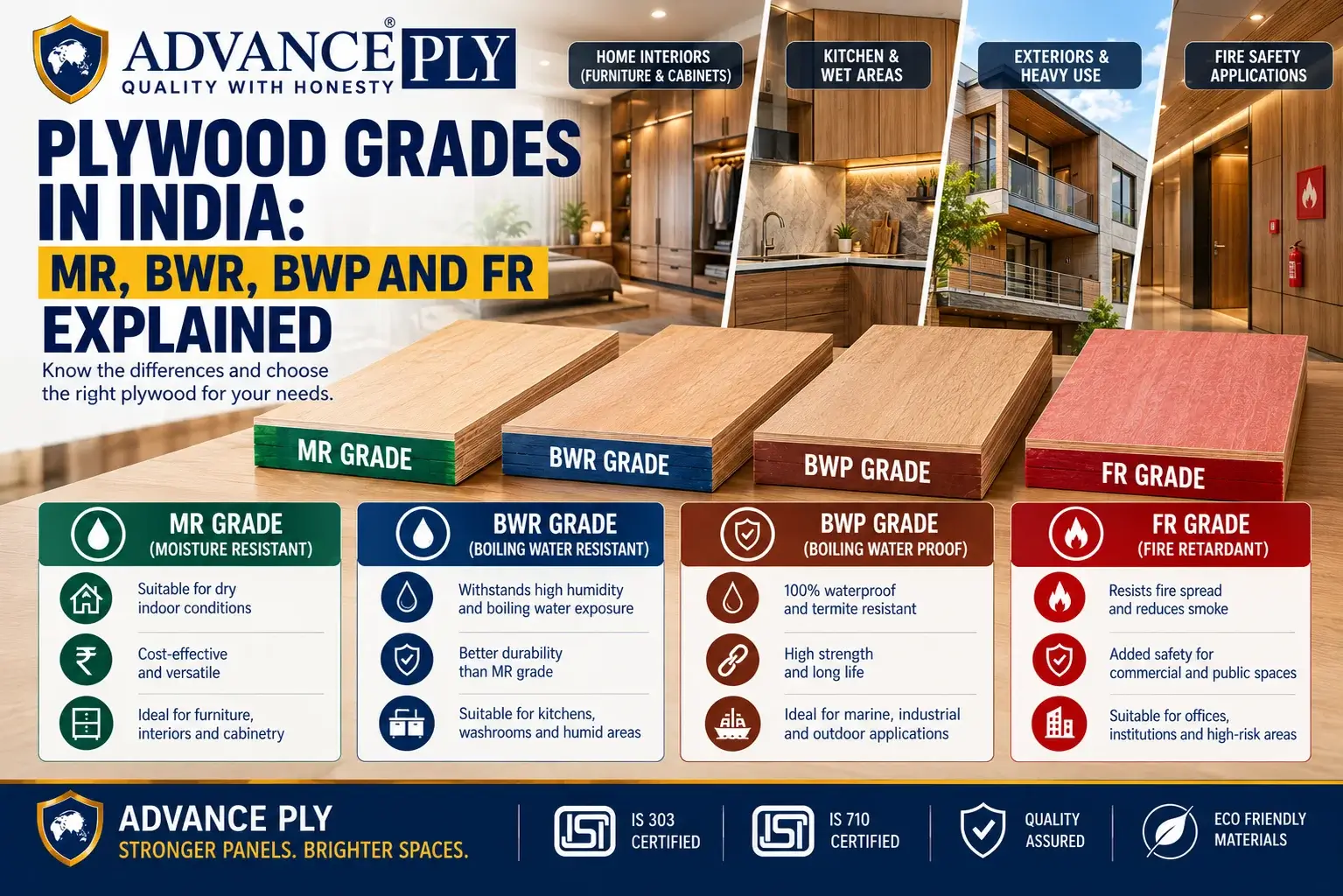
What are the plywood grades in India?
Indian plywood is graded by how it behaves in water and fire, not by how it looks. IS 303:2024 covers MR, BWR and BWP grades for general purpose plywood. IS 710:2024 covers marine grade. IS 5509:2021 covers fire retardant. The grade is printed on the board edge alongside the ISI mark and a CM/L licence number, and that printed mark is the only version that counts.
The Grades at a Glance
Five grades are sold in India. Four of them sit under two standards, and the fifth is a fire classification that can be combined with the others.
| Grade | Standard | What it means | Bonding resin | Where it belongs |
|---|---|---|---|---|
| MR | IS 303:2024 | Moisture resistant. Handles humidity in the air, not water on the surface | Urea formaldehyde, often melamine fortified | Wardrobes, beds, study tables, dry interiors |
| BWR | IS 303:2024 | Boiling water resistant. Handles steam, splashes and wet wiping | Melamine fortified urea formaldehyde or phenolic | Kitchen carcasses, vanity units, semi exterior |
| BWP | IS 303:2024 | Boiling water proof under the general purpose standard | Phenol formaldehyde | Modular kitchens, sink units, utility areas |
| BWP marine | IS 710:2024 | Boiling water proof under the marine standard, with mandatory preservative treatment | Phenol formaldehyde | Direct water contact, coastal work, boat interiors |
| FR | IS 5509:2021 | Fire retardant. Delays ignition and slows flame spread | Phenol formaldehyde with fire retardant treatment | Hotels, hospitals, schools, commercial interiors |
FR is not a water grade. A board can be fire retardant and marine grade at the same time, and the two certifications are printed separately on the edge.
What Changed in 2024, and Why Most Plywood Guides are Now Out of Date?
Until recently the rule was simple and every guide repeated it: IS 303 covers MR and BWR, and BWP means IS 710 marine. That rule is no longer complete.
IS 303 was revised in 2024, its fourth revision. Among the modifications, the revision introduced a boiling water proof grade under IS 303 itself. The previous edition, IS 303:1989, had deleted BWR and CWR grades and carried MR as the lower grade, so the standard genuinely did cover only MR and BWR for thirty-five years. Most published guidance was written during that period and has not been updated.
The practical consequence matters when you read a board edge. A sheet marked IS 303 with BWP grade is now a legitimate marking, not a printing error and not a misrepresentation. It means the board is boiling water proof under the general-purpose standard.
What this does not mean: IS 303 BWP is not the same as IS 710 marine. IS 710 is a separate standard written for marine and river craft, and it makes preservative treatment mandatory along with a harder water resistance requirement. A board can be boiling water proof under IS 303 without being marine grade. Read the IS number, not only the grade word.
Three other standards were revised in the same period. IS 710 moved to its 2024 third revision, IS 4990 for concrete shuttering to its 2024 fourth revision, and IS 5509 for fire retardant plywood sits at its 2021 third revision. IS 1659 for block boards remains at 2004. If a brochure cites IS 5509:2024, the edition does not exist.
MR Grade, The Interior Baseline
- Right for: wardrobes, beds, study tables, bookshelves, TV units, partitions and any conditioned interior.
- Wrong for: kitchen carcasses, bathroom vanities, utility areas, balconies and anywhere water can sit.
BWR Grade, The Kitchen Workhorse
BWR stands for boiling water resistant. It sits above MR under the same IS 303 standard and is the grade most Indian kitchens are actually built from.
Resistant is the operative word. A BWR board survives steam, splashes, condensation and repeated wet wiping. It is not rated for immersion, and it should not be specified for a sink base or a shower adjacent panel. The bonding is typically melamine fortified urea formaldehyde, and the board is normally treated against termite and borer at the glue line.
Advance Ply 710 is a BWR board under IS 303, published at 72 hours of water resistance at 100 degrees Celsius, with average density of 0.65 grams per cubic centimetre and screw holding above 1300 newtons.
A naming point to be clear about: Advance Ply 710 is licensed under IS 303:2024 as BWR grade. It is not an IS 710 marine board, and the number in the product name is a brand name rather than a standard. The board edge prints IS 303 with the ISI mark and the BIS licence number, and that marking is the certification. Several Indian brands sell boards named 710 that are licensed the same way, so the check applies across the market: read the IS number on the edge, not the name on the face.
- Right for: kitchen carcasses away from the sink, vanity units, semi wet zones, covered balconies, utility storage.
- Wrong for: sink bases, dishwasher surrounds, exposed exterior work, coastal direct exposure.
BWP Grade Under IS 303
BWP stands for boiling water proof. Under the fourth revision of IS 303 this is now the top grade of the general-purpose standard. It is bonded with phenol formaldehyde resin, which is what makes the boiling water performance possible. Urea formaldehyde cannot deliver it, whatever the label says.
This grade is the right answer for most premium interior work. It gives genuine boiling water performance without paying for the marine preservative regime that a kitchen will never call on.
Two Advance Ply boards sit here. Gold is IS 303:2024 BWP with E1 MPF resin, average density 0.78 grams per cubic centimetre, screw holding above 1600 newtons, and boiling water proof performance up to 200 hours. PF is IS 303:2024 BWP with the same resin class, density 0.72, screw holding above 1500 newtons and the same 200 hour figure. The difference between them is core construction: Gold is hardwood throughout; PF uses alternate construction.
Gold and PF are not marine grade: Both are boiling water proof under IS 303:2024, and both board edges carry IS 303 with the ISI mark and the BIS licence number. They are the correct specification for kitchens, bathrooms and utility areas. They are not certified for the sustained water contact that IS 710 covers. If a project calls for marine grade, the boards are Tungsten, Palladium or Gold Marine.
- Right for: modular kitchens including sink runs, bathroom vanity units, utility and washing zones, premium wardrobes, commercial interiors.
Marine Grade Under IS 710
IS 710 is a separate standard, not a higher rung of IS 303. It was written for the construction, repair and maintenance of marine and river craft, pontoons and similar structures, and it was last revised in 2024 as its third revision.
Two things distinguish it. The water requirement is harder, with IS 710 requiring 72 hours of boiling as its baseline. And preservative treatment is mandatory rather than optional, which is why genuine marine boards carry a CCB marking for copper chrome boron treatment and publish a retention figure.
That retention figure is worth asking for by name. It is the quantity of preservative held in the board, and a brand that publishes it can be checked. Advance Ply publishes 12.5 kilograms per cubic metre on Tungsten and Palladium.
Marine grade and BWP describe the same water behaviour, which is why the two words are used interchangeably in shops. Since the 2024 revision that shorthand is no longer safe, because BWP now also exists under IS 303. Marine means IS 710. BWP alone does not.
Gold and PF are not marine grade: Both are boiling water proof under IS 303:2024, and both board edges carry IS 303 with the ISI mark and the BIS licence number. They are the correct specification for kitchens, bathrooms and utility areas. They are not certified for the sustained water contact that IS 710 covers. If a project calls for marine grade, the boards are Tungsten, Palladium or Gold Marine.
- Right for: modular kitchens including sink runs, bathroom vanity units, utility and washing zones, premium wardrobes, commercial interiors.
Specifying a Board for Direct Water Contact?
Three Advance Ply boards are licensed under IS 710:2024, with boiling water figures and preservative retention published for each one.
Which Advance Ply Board carries which Standard
Both standards produce boards described as boiling water proof, and the two are easy to confuse in a showroom. This is the exact split, and every entry matches the IS number printed on that board edge.
| Board | Standard on the edge | What it is certified for |
|---|---|---|
| Tungsten | IS 710:2024 and IS 5509:2021 | Marine grade and fire retardant on one sheet |
| Palladium | IS 710:2024 and IS 5509:2021 | Marine grade and fire retardant on one sheet |
| Gold Marine | IS 710:2024 | Marine grade |
| Gold FR | IS 5509:2021 | Fire retardant |
| Gold | IS 303:2024 | BWP under the general-purpose standard |
| PF | IS 303:2024 | BWP under the general-purpose standard |
| 710 | IS 303:2024 | BWR under the general-purpose standard |
| MMR25 Plus, MMR25, MMR10 Plus, MMR10 | IS 303:2024 | MR grade for dry interiors |
Three boards are marine grade: Tungsten, Palladium and Gold Marine. Two are boiling water proof without being marine: Gold and PF. One is boiling water resistant: 710. The rest are moisture resistant. Read the IS number on the edge and the question answers itself.
FR Grade Under IS 5509
Fire retardant plywood is covered by IS 5509, currently at its 2021 third revision. It is not a water grade and it does not replace one. The treatment is applied during manufacture, and the standard specifies the fire-retardant chemicals, the method of treatment, the retentions and the performance requirements.
Three properties are tested: flammability, flame penetration and rate of burning. A brand that claims fire retardancy without publishing those three numbers has given you nothing you can check.
The term is fire retardant, not fireproof. Plywood is a wood product. Treatment delays ignition and slows flame spread, which buys evacuation time and limits how fast a fire crosses a surface. Any brand describing a board as fireproof is overstating what the standard certifies.
Advance Ply publishes flame penetration above 60 minutes, flammability above 45 minutes and rate of burning above 30 minutes on Tungsten, Palladium and Gold FR.
The combination worth knowing about: A board can carry IS 710 and IS 5509 at the same time, which means marine grade and fire retardant on one sheet. Most brands sell a marine range and a separate fire-retardant range, so a project with both a moisture requirement and a fire requirement has to run two materials. Advance Ply Tungsten and Palladium carry both numbers on the board edge.
Specifying for a Hotel, Hospital or School?
See the three boards licensed under IS 5509:2021, with flame penetration, flammability and rate of burning published in minutes.
How Each Grade is Actually Tested?
Grades are not marketing tiers. Each one is a pass or fail against a laboratory test, and knowing which test applies tells you what the grade can and cannot promise.
| Grade | What is tested | What the test proves |
|---|---|---|
| MR | Water resistance by cycles in heated water, plus bond strength | The glue line holds under humidity and brief damp, not under immersion |
| BWR | Water resistance under boiling conditions, plus glue shear strength dry and wet | The bond survives steam and splashing but is not rated for standing water |
| BWP, IS 303 | Boiling water resistance, glue adhesion, static bending strength | The phenolic bond holds through sustained boiling without delaminating |
| BWP Marine, IS 710 | Boiling water resistance, glue adhesion, preservative retention, resistance to microorganism | The bond and the timber both survive prolonged water contact and biological attack |
| FR, IS 5509 | Flammability, flame penetration and rate of burning under IS 1734 Part 3, plus water resistance and static bending under IS 303 | The board delays ignition and slows flame spread by a measured number of minutes |
The fire test scheme for IS 5509 is published by the Bureau of Indian Standards in its product manual for the standard, which names IS 1734 Part 3 as the test method for flame penetration and rate of burning. Ask any supplier claiming FR grade for the test report against those clauses.
Which Grade Belongs in which Room?
Specify by exposure, not by room name. A dry bedroom wardrobe and a utility room wardrobe are the same furniture facing different conditions.
| Location | Grade | Reasoning |
|---|---|---|
| Bedroom wardrobes, beds, study tables | MR | Conditioned dry air. Paying for boiling water performance here buys nothing |
| Living room units, bookshelves, partitions | MR | Same reasoning. Prioritise screw holding and calibration over water grade |
| Kitchen carcasses away from the sink | BWR | Steam and wet wiping, no standing water |
| Sink base, dishwasher surround, under counter | BWP | Leaks happen. This is the one zone where the upgrade pays for itself |
| Bathroom vanity units | BWP | Constant humidity and direct splash |
| Utility and washing zones | BWP | Water on the floor and on the surfaces |
| Covered balconies, semi exterior | BWP or Marine | Depends on whether rain reaches the surface |
| Coastal homes, any room | Marine, IS 710 | Salt laden air attacks the glue line and the timber together |
| Hotels, hospitals, schools, offices | FR, IS 5509 | Fire regulations govern. Combine with a water grade where the zone is wet |
| Boat interiors, dock structures | Marine, IS 710 | The application the standard was written for |
How to Check the Grade on a Board Before you Buy?
Every claim above is printed on the board. Six checks take under two minutes at the dealer counter.
- Find the IS number on the edge: It is printed along the long edge with the ISI mark. IS 303, IS 710 or IS 5509. A board with no IS number has no grade, whatever the invoice says.
- Read the grade word next to it: MR, BWR, BWP or FR. Check that the pairing makes sense: FR belongs with IS 5509, marine with IS 710.
- Find the CM/L licence number: A genuine ISI mark carries a licence number. A printed ISI logo without one is not a valid mark. Verify the number on the BIS Care app.
- Ask for the technical specification sheet: It should give density, screw holding, glue shear strength and, for marine grades, preservative retention. A brand that cannot produce one is asking you to take the grade on trust.
- Look at the cut edge: Core gaps are visible. A board with voids will not hold a screw at the edge regardless of its grade.
- Lift the sheet: Density is a grade indicator you can feel. A hardwood board at 0.75 grams per cubic centimetre and above is noticeably heavier than a poplar core board.
If the board, the specification sheet and the invoice disagree about the grade, the board edge is the one that counts. It is the marking the manufacturer is licensed against.
Where the Advance Ply Range Sits?
Thirteen plywood products across four grades. Every figure below is published on the product specification sheet.
| Product | Standard | Grade | Density | Screw holding | Warranty |
|---|---|---|---|---|---|
| Tungsten | IS 710:2024 and IS 5509:2021 | BWP marine and FR | 0.78 g/cm³ | Above 1600 N | Lifetime |
| Palladium | IS 710:2024 and IS 5509:2021 | BWP marine and FR | 0.75 g/cm³ | Above 1600 N | 36 years |
| Gold Marine | IS 710:2024 | BWP marine | 0.75 g/cm³ | Above 1600 N | 35 years |
| Gold FR | IS 5509:2021 | FR | 0.68 g/cm³ | Above 1500 N | 30 years |
| Gold | IS 303:2024 | BWP | 0.78 g/cm³ | Above 1600 N | 30 years |
| PF | IS 303:2024 | BWP | 0.72 g/cm³ | Above 1500 N | 20 years |
| 710 | IS 303:2024 | BWR | 0.65 g/cm³ | Above 1300 N | 15 years |
| Gold MMR25 Plus | IS 303:2024 | MR | 0.70 g/cm³ | Above 1350 N | 25 years |
| Gold MMR25 | IS 303:2024 | MR | 0.65 g/cm³ | Above 1300 N | 15 years |
| MMR10 Plus | IS 303:2024 | MR | 0.70 g/cm³ | Above 1350 N | 15 years |
| MMR10 | IS 303:2024 | MR | 0.65 g/cm³ | Above 1300 N | 10 years |
Two products sit outside the grade ladder. Flexi is a flexible plywood for curved work, bonded with urea formaldehyde at Class E2 emission, available from 5 to 11 millimetres. Shuttering plywood is a film faced panel for concrete formwork rather than furniture.
Emission Class, the Second Grading System Most Buyers Miss
Water grade is one axis. Formaldehyde emission is a second, and it is graded separately with its own letter scale. A board can be marine grade and still sit at the weakest emission class, because the two measure different things.
| Class | What it means | Where it matters |
|---|---|---|
| E0 | The lowest emission class in common use | Enclosed spaces, bedrooms, children's rooms, healthcare interiors, anywhere the board sits behind closed shutters |
| E1 | Low emission, the mainstream class for quality interior plywood | General residential and commercial furniture |
| E2 | The weakest of the three | Flexible and specialist boards where the construction limits what resin can be used |
The reason to care is simple. Plywood sits in wardrobes and kitchen cabinets that stay shut for hours, and emission is a property of the resin rather than the surface. It does not reduce with lamination and it does not show in a showroom.
Across the Advance Ply range, Tungsten is the only plywood at E0. Palladium, Gold Marine, Gold FR, Gold and PF sit at E1. Flexi is Class E2, which follows from its urea formaldehyde bonding and its flexible construction. Tungsten additionally carries an indoor air toxicity compliance mark, which no other board in the range holds.
One wording point worth checking on any brand: The class is written E0 with a zero, not EO with a letter. The two look identical in most typefaces and the substitution appears regularly in published product copy, including on brand sites that otherwise get the technical detail right.
What the Grade does not tell you?
Grade answers one question: how the board behaves in water. It is silent on four properties that decide whether furniture survives, and two boards of the same grade can differ substantially on all four.
Core construction: A hardwood core and an alternate core can hold the same grade. Hardwood is denser, holds a screw harder and stays flatter over a long span. Alternate construction mixes species and costs less. The grade mark will not distinguish them, so read the base material line on the specification sheet.
Density: Published in grams per cubic centimetre, and it varies more than most buyers expect. Across the Advance Ply range the spread runs from 0.65 to 0.78, which is a real difference in weight, screw grip and load bearing. Density is also the one property you can assess by hand before you buy.
Screw holding capacity: Measured in newtons and the figure that decides whether a hinge stays tight after five years of a shutter being pulled. A board at above 1600 newtons and one at above 1300 newtons are both legitimately graded, and they are not the same product.
Calibration: Whether the sheet has been machined to a uniform thickness on both faces. It does not affect water performance at all, and it decides whether CNC cuts land clean and whether edge banding sits flush. On any job going through a machine, an uncalibrated board of a higher grade is the worse choice.
There is a fifth, specific to marine grade. Preservative treatment is mandatory under IS 710, but the retention figure is not always published. A board can be correctly marked IS 710 while the brand declines to state how much preservative the timber actually holds. Ask for the number in kilograms per cubic metre.
Five Mistakes Worth Avoiding
Treating marine grade as the answer to everything: A bedroom wardrobe in marine ply is money spent on a property the furniture will never use. Specify by exposure.
Reading a product name as a grade: Several brands sell boards named 710 that are licensed under IS 303. The name is a name. The IS number on the edge is the certification.
Accepting proof and resistant as interchangeable: Boiling water resistant and boiling water proof are different grades with different tests. If a board is marked BWR, the word proof should not appear anywhere in its description.
Assuming fire retardant means fireproof: FR grade delays ignition and slows flame spread by a measured number of minutes. It does not make plywood non combustible.
Specifying the grade and ignoring the core: Two boards of the same grade can differ by 0.13 grams per cubic centimetre in density and 300 newtons in screw holding. Grade tells you about water. Density and screw holding tell you whether the hinge stays tight.
Compare Every Advance Ply Board On The Numbers, Not The Name
Density, screw holding, glue shear strength and boiling water performance for all eleven boards, in one table.
Not sure which grade your project needs? Talk to the technical team.
Frequently Asked Questions
What are the plywood grades in India?
India uses five plywood grades. MR, BWR and BWP fall under IS 303:2024 for general purpose plywood. BWP marine grade falls under IS 710:2024. FR, fire retardant, falls under IS 5509:2021. The grade and the IS number are printed on the board edge with the ISI mark.
Is BWP the same as marine plywood?
Not anymore. BWP marine plywood is certified under IS 710:2024. Since the fourth revision of IS 303 in 2024, a BWP grade also exists under IS 303 for general purpose plywood. Both are boiling water proof, but only IS 710 is marine grade with mandatory preservative treatment. Read the IS number, not only the grade word.
What is the difference between BWR and BWP plywood?
BWR is boiling water resistant and BWP is boiling water proof. BWR handles steam, splashes and wet wiping. BWP handles sustained contact with boiling water without the glue line delaminating. BWP is bonded with phenol formaldehyde resin, which is what makes the difference.
Which plywood grade is best for a modular kitchen?
BWR for the carcasses away from the sink and BWP for the sink base, the dishwasher surround and any under counter run where a leak can sit. Specifying BWP for the whole kitchen is defensible but the upgrade earns its place in the wet zones.
Does IS 303 cover BWP grade?
Yes, since the fourth revision in 2024. The previous edition, IS 303:1989, covered MR and BWR only, which is why most published guides still state that BWP exists only under IS 710. A board marked IS 303 with BWP grade is a valid marking.
What does MR grade plywood mean?
MR means moisture resistant. It is bonded with urea formaldehyde resin, often fortified with melamine, and it handles ambient humidity rather than water on the surface. It is the correct grade for wardrobes, beds, study tables and dry interiors.
Is fire retardant plywood the same as fireproof plywood?
No. Fire retardant plywood is treated to delay ignition and slow flame spread, measured as flammability, flame penetration and rate of burning under IS 5509. Plywood is a wood product and cannot be made non combustible. Any brand describing a board as fireproof is overstating the certification.
How do I check the grade of a plywood sheet?
Read the board edge. The IS number, the grade word, the ISI mark and a CM/L licence number are printed along the long edge. Verify the licence number on the BIS Care app, then ask the dealer for the technical specification sheet and check that the grade on the sheet matches the grade on the board.
Can plywood be marine grade and fire retardant at the same time?
Yes. A board can carry IS 710 and IS 5509 together, with both numbers printed on the edge. It is uncommon in the Indian market because most brands run separate marine and fire retardant ranges. Advance Ply Tungsten and Palladium carry both.
Is Advance Ply 710 marine plywood?
No. Advance Ply 710 is licensed under IS 303:2024 as BWR grade, boiling water resistant. The board edge prints IS 303 with the ISI mark and the BIS licence number. The number in the product name is a brand name and carries no regulatory meaning. The marine grade boards in the range are Tungsten, Palladium and Gold Marine, all certified under IS 710:2024.
Why is a plywood product called 710 when it is licensed under IS 303?
Product names are brand names, not certifications. Several Indian brands sell boards named 710 that are licensed under IS 303 as BWR grade. The number in a product name carries no regulatory meaning. Only the IS number printed on the board edge does.