Fire Retardant Plywood
IS 5509 certified fire retardant plywood that holds back flame penetration for over 60 minutes, built for hotels, hospitals, offices, schools and any interior where a fire officer has to sign off the materials.
- IS 5509:2021
- 60+ Min Flame Penetration
- 45+ Min Flammability
- 30+ Min Rate of Burning
- NAFRG Technology
- Up to Lifetime Warranty
- Home
- All Plywood Range
- FIRE RETARDANT PLYWOOD
Years of Legacy
Families Served
States Covered
Authorized Dealers
Premium Plywood sheets Produced
Fire retardant plywood is plywood manufactured and treated to resist ignition and slow the spread of flame. In India it is covered by IS 5509, currently at its third revision dated 2021, and tested by the method in IS 1734 Part 3. A certified board is tested on three separate counts: flame penetration, flammability and rate of burning. Advance Ply publishes all three figures for every fire retardant board it makes. No plywood is fireproof. What these boards buy is time.
What Is Fire Retardant Plywood?
Fire retardant plywood is plywood that has been built to behave differently when fire reaches it. The treatment does not stop the board burning, because wood burns. What it does is push back the moment the board catches, and slow the rate at which flame travels across and through it.
That delay is the entire product. In a building fire, the difference between a surface that ignites in four minutes and one that resists for forty five is the difference between an evacuation that works and one that does not. It is also the difference between a fire contained in one room and a fire that has travelled through the joinery into the corridor.
In India the property is certified under IS 5509. A board carrying that licence has been tested in a laboratory to the method set out in IS 1734 Part 3, and the standard sets thresholds for three distinct behaviours rather than one. This is why a single number quoted as a fire rating is almost always incomplete.
Fire retardant is a separate certification from water performance. A board can be fire retardant and nothing else, as Advance Gold FR is. Or it can carry fire retardant certification alongside marine grade certification under IS 710, as Advance Tungsten and Advance Palladium do. The board edge prints both IS numbers when both apply.
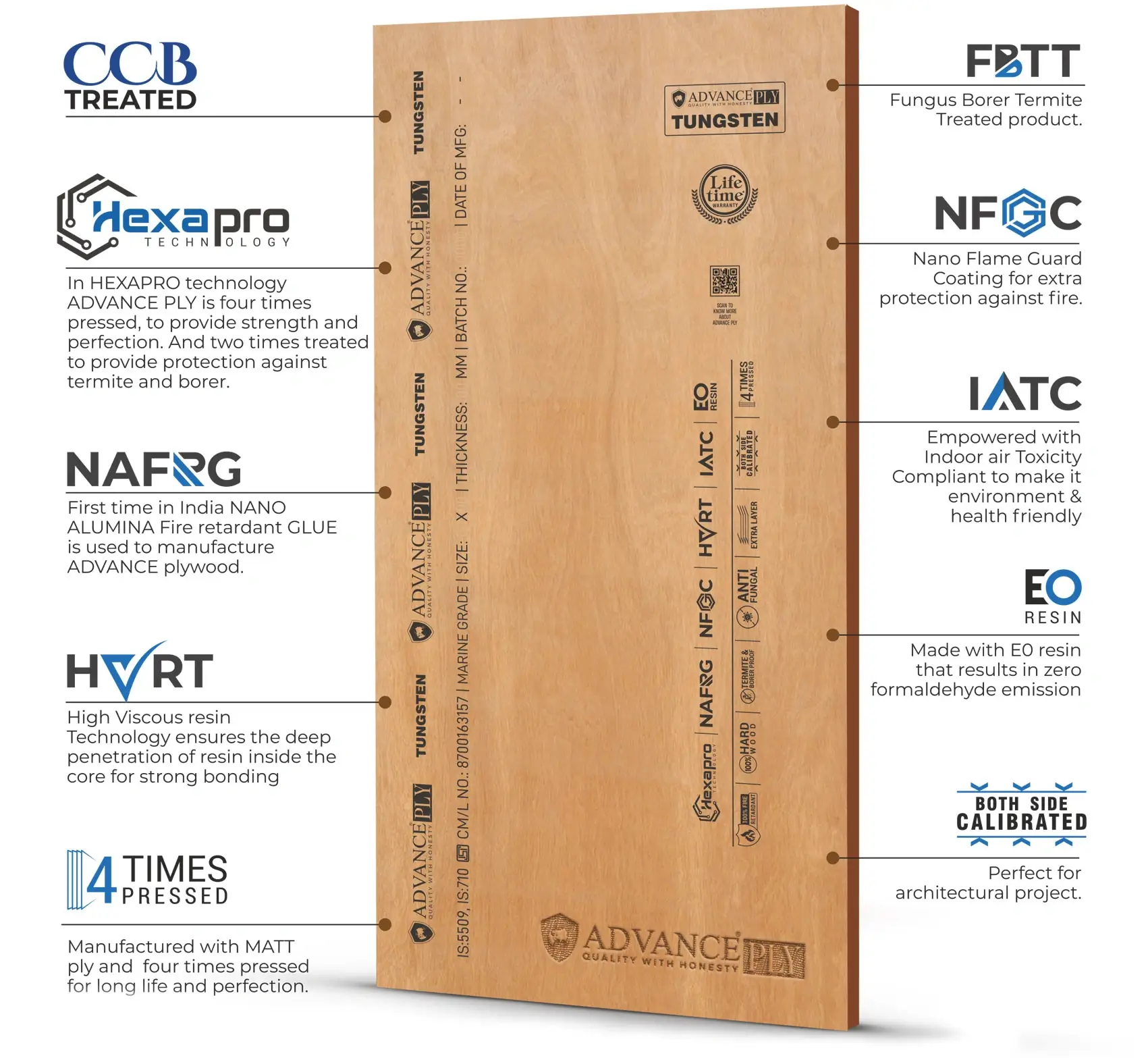
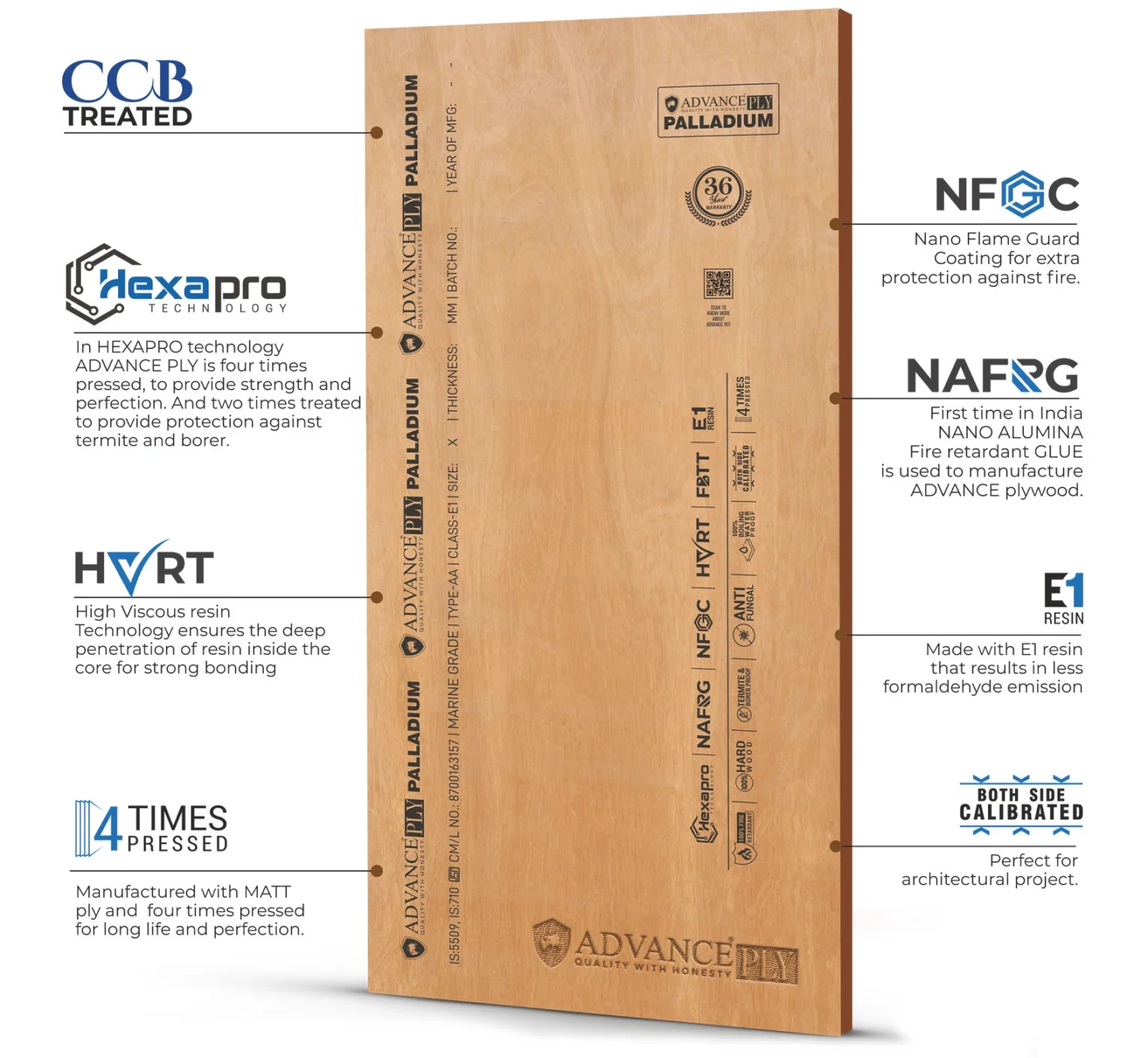
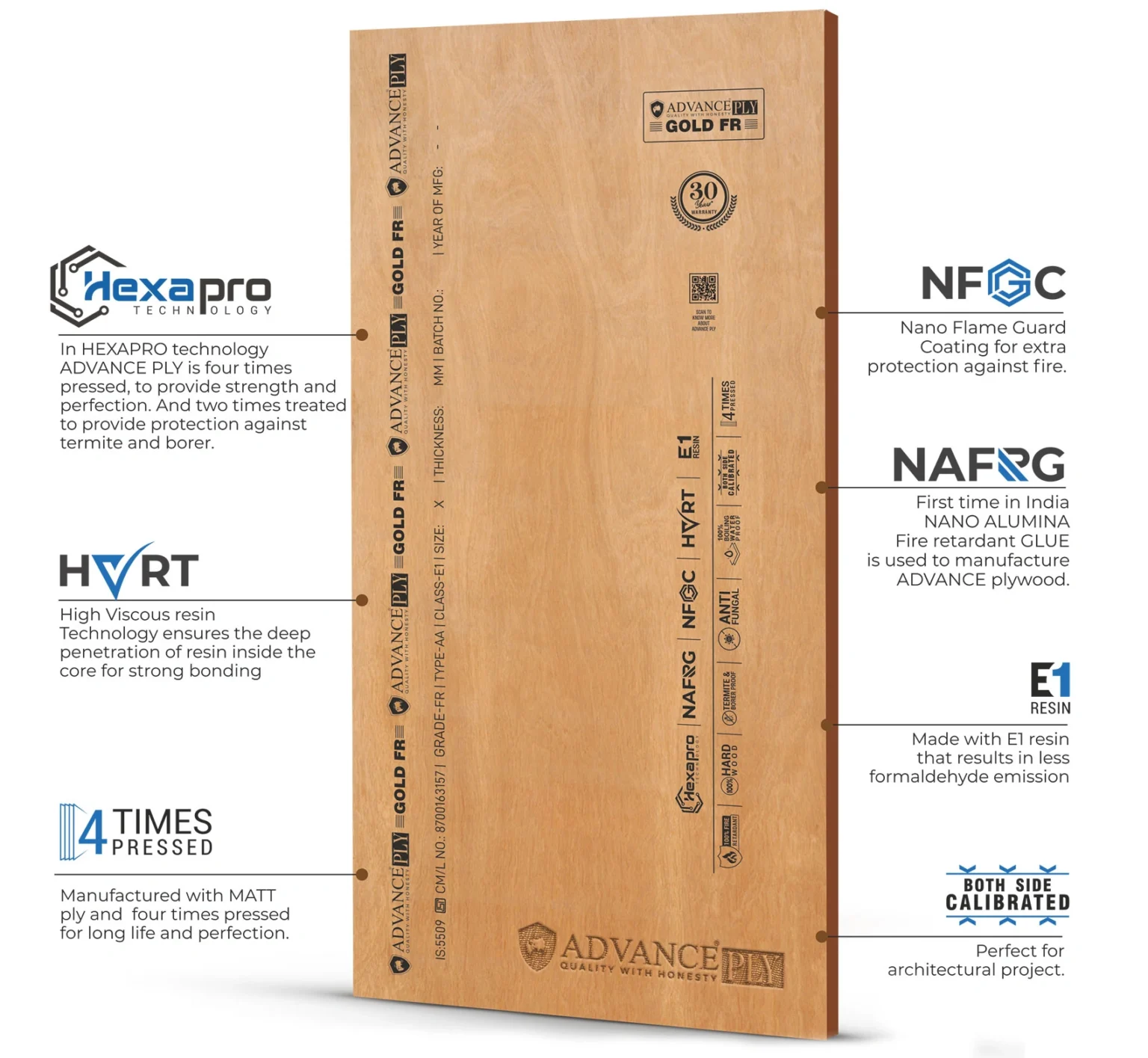
The Advance Ply Fire Retardant Range
Three boards, covering the three situations in which fire performance is specified.


Advance Ply Tungsten Product Specifications
The top of the range. Licensed under IS 710:2024 as marine grade and under IS 5509:2021 as fire retardant, on the same board, with both IS numbers printed on the edge. Thirteen layer hardwood construction, average density 0.78 grams per cubic centimetre, screw holding above 1600 newtons and more than 250 hours of boiling water performance.
| Specification | Value |
|---|---|
| Indian Standard | IS 710:2024 and IS 5509:2021 |
| Grade | BWP marine grade with fire retardant certification |
| Construction | 13 layer |
| Core | 100% Hardwood |
| Bonding resin | Phenol formaldehyde |
| Formaldehyde emission class | E0 |
| Density | Average 0.78 g/cm³ |
| Moisture content | 5 to 15 percent |
| Thickness range | 6 to 19 mm |
| Screw holding strength | More than 1600 N |
| Resistance to micro-organisms | More than 1700 N |
| Compressive strength | More than 6000 N |
| Boiling water performance | More than 250 hours |
| Flame penetration | More than 60 minutes |
| Flammability | More than 45 minutes |
| Rate of burning | More than 30 minutes |
| Modulus of rupture, dry, along the grain (N/mm², average / minimum) | 49 / 43 |
| Modulus of rupture, dry, across the grain (N/mm², average / minimum) | 40 / 35 |
| Modulus of elasticity, dry, along the grain (N/mm², average / minimum) | 6980 / 6359 |
| Modulus of elasticity, dry, across the grain (N/mm², average / minimum) | 4893 / 4356 |
| Modulus of rupture, wet, along the grain (N/mm², average / minimum) | 35 / 30 |
| Modulus of rupture, wet, across the grain (N/mm², average / minimum) | 26 / 23 |
| Modulus of elasticity, wet, along the grain (N/mm², average / minimum) | 3591 / 3245 |
| Modulus of elasticity, wet, across the grain (N/mm², average / minimum) | 2678 / 2430 |
| Tensile strength, along the grain | 50 N/mm² |
| Tensile strength, across the grain | 40 N/mm² |
| Tensile strength, sum of both directions | 90 N/mm² |
| Glue shear strength, dry (N, average / minimum) | 1563 / 1427 |
| Glue shear strength, wet (N, average / minimum) | 1233 / 1156 |
| Preservative retention | 12.5 kg per cubic metre |
| Warranty | Lifetime |
It is also the only board in the range carrying an E0 formaldehyde emission class, the lowest offered. For a hospital ward, a hotel guest room or a nursery, where the board sits behind closed shutters in an enclosed space, that matters as much as the fire figures. Lifetime warranty.
Advance Ply Palladium Product Specifications
The same two certifications, IS 710:2024 and IS 5509:2021, at an E1 emission class. Average density 0.75, screw holding above 1600 newtons, boiling water proof, and the highest wet glue shear strength in the fire retardant range at 1310 newtons average. Thirty six year warranty.
| Specification | Value |
|---|---|
| Indian Standard | IS 710:2024 and IS 5509:2021 |
| Grade | BWP marine grade with fire retardant certification |
| Core | 100% Hardwood |
| Bonding resin | Phenol formaldehyde |
| Formaldehyde emission class | E1 |
| Density | Average 0.75 g/cm³ |
| Moisture content | 5 to 15 percent |
| Thickness range | 6 to 19 mm |
| Screw holding strength | More than 1600 N |
| Resistance to micro-organisms | More than 1700 N |
| Compressive strength | More than 5500 N |
| Boiling water performance | Boiling water proof |
| Flame penetration | More than 60 minutes |
| Flammability | More than 45 minutes |
| Rate of burning | More than 30 minutes |
| Modulus of rupture, dry, along the grain (N/mm², average / minimum) | 49 / 43 |
| Modulus of rupture, dry, across the grain (N/mm², average / minimum) | 40 / 36 |
| Modulus of elasticity, dry, along the grain (N/mm², average / minimum) | 6589 / 6036 |
| Modulus of elasticity, dry, across the grain (N/mm², average / minimum) | 4890 / 4352 |
| Modulus of rupture, wet, along the grain (N/mm², average / minimum) | 27 / 25 |
| Modulus of rupture, wet, across the grain (N/mm², average / minimum) | 22 / 20 |
| Modulus of elasticity, wet, along the grain (N/mm², average / minimum) | 3456 / 3289 |
| Modulus of elasticity, wet, across the grain (N/mm², average / minimum) | 2564 / 2340 |
| Tensile strength, along the grain | 48 N/mm² |
| Tensile strength, across the grain | 38 N/mm² |
| Tensile strength, sum of both directions | 86 N/mm² |
| Glue shear strength, dry (N, average / minimum) | 1456 / 1348 |
| Glue shear strength, wet (N, average / minimum) | 1310 / 1236 |
| Preservative retention | 12.5 kg per cubic metre |
| Warranty | 36 years |
This is the specification for commercial interiors where fire performance and water exposure both apply and the project does not specifically call for E0.
Advance Ply Gold FR Product Specifications
Fire performance for dry interiors. Licensed under IS 5509:2021, eleven layer construction in 19 mm, average density 0.68, screw holding above 1500 newtons and more than 100 hours of boiling water performance. Thirty year warranty.
| Specification | Value |
|---|---|
| Indian Standard | IS 5509:2021 |
| Grade | Fire retardant |
| Construction | 11 layer in 19 mm |
| Bonding resin | Phenol formaldehyde with fire retardant treatment |
| Formaldehyde emission class | E1 |
| Density | Average 0.68 g/cm³ |
| Moisture content | 5 to 15 percent |
| Thickness range | 6 to 19 mm |
| Screw holding strength | More than 1500 N |
| Compressive strength | More than 5500 N |
| Boiling water performance | More than 100 hours |
| Flame penetration | More than 60 minutes |
| Flammability | More than 45 minutes |
| Rate of burning | More than 30 minutes |
| Modulus of rupture, dry, along the grain (N/mm², average / minimum) | 40 / 37 |
| Modulus of rupture, dry, across the grain (N/mm², average / minimum) | 29 / 25 |
| Modulus of elasticity, dry, along the grain (N/mm², average / minimum) | 4656 / 4050 |
| Modulus of elasticity, dry, across the grain (N/mm², average / minimum) | 3258 / 3089 |
| Glue shear strength, dry (N, average / minimum) | 1203 / 1126 |
| Glue shear strength, wet (N, average / minimum) | 1029 / 959 |
| Preservative treatment | Surface treatment |
| Warranty | 30 years |
Specify it where the requirement is fire retardancy and the board will not face standing water. For a hotel corridor panel or an office cabin, this is the board. For a commercial kitchen, move up to Tungsten or Palladium.
Compare the Three Advance Ply Fire Retardant Grades
| Specification | Advance Tungsten | Advance Palladium | Advance Gold FR |
|---|---|---|---|
| Standard | IS 710:2024 and IS 5509:2021 | IS 710:2024 and IS 5509:2021 | IS 5509:2021 |
| Grade | BWP marine and FR | BWP marine and FR | FR |
| Emission class | E0 | E1 | E1 |
| Average density (g/cm³) | 0.78 | 0.75 | 0.68 |
| Screw holding | More than 1600 N | More than 1600 N | More than 1500 N |
| Flame penetration | More than 60 minutes | More than 60 minutes | More than 60 minutes |
| Flammability | More than 45 minutes | More than 45 minutes | More than 45 minutes |
| Rate of burning | More than 30 minutes | More than 30 minutes | More than 30 minutes |
| Boiling water | More than 250 hours | Boiling water proof | More than 100 hours |
| Glue shear, wet (N), average / minimum | 1233 / 1156 | 1310 / 1236 | 1029 / 959 |
| Compressive strength | More than 6000 N | More than 5500 N | More than 5500 N |
| Preservative retention | 12.5 kg per cubic metre | 12.5 kg per cubic metre | Surface treatment |
| Warranty | Lifetime | 36 years | 30 years |
| Specify it when | The board faces fire risk and water together, and indoor air matters most | The board faces fire risk and water together in a residential or commercial interior | The requirement is fire performance in a dry interior |
What the Three Fire Test Figures Actually Mean?
This is the part that decides whether you are comparing boards or comparing marketing. IS 5509 does not produce one fire rating. It produces three, and they measure different things.
| Test | Advance Ply range | What it measures |
|---|---|---|
| Flame penetration | More than 60 minutes | How long a flame takes to burn right through the board from one face to the other. This is the figure that matters for a partition or a door, because it governs how long the board holds the fire on one side of it. |
| Flammability | More than 45 minutes | How long the board resists sustaining a flame of its own once a flame is held against it. This governs how readily the surface itself becomes part of the fire rather than just fuel sitting next to it. |
| Rate of burning | More than 30 minutes | How long the board takes to be consumed under the test conditions. This is the slowest of the three thresholds and the one most often quoted on its own, which is why figures from different brands so rarely compare. |
There is a fourth question worth asking, which no figure on any sheet answers: where does the retardant chemistry sit. A coating on the surface and chemistry built into the glue line behave identically on day one and very differently after the board has been cut, routed, sanded and lived with for ten years.
IS 5509 and IS 710 on the Same Fire Retardant Plywood Board
Two standards, two separate licences, one board. IS 710:2024 certifies marine grade boiling water performance with mandatory preservative treatment. IS 5509:2021 certifies fire retardant performance. They test different properties and neither implies the other.
Advance Ply Tungsten and Advance Ply Palladium hold both. The board edge prints both IS numbers alongside the ISI mark and the BIS licence number, and the specification sheet carries both sets of figures.
Where that combination gets specified
- Commercial kitchens: Heat, steam, standing water and a fire risk that is part of the daily operation rather than an accident.
- Hotel bathrooms and wet areas: Fire approval covers the whole guest room, and the vanity unit sits in standing water.
- Hospital utility and sluice rooms: Washed down daily, inside a building where evacuation is slow.
- Coastal commercial projects Salt laden humidity attacks the board continuously while the fire requirement still applies.
- Laboratory and pantry joinery Water at the sink, heat at the bench, and an institutional fire specification over both.
IS 5509:2021 and IS 710:2024 certified plywood, phenol formaldehyde bonded, 100% hardwood construction, CCB preservative treated.
Where only one of the two applies, specify only the one you need. A dry office cabin does not need marine grade, and Advance Gold FR is the board written for that case.
Where Fire Retardant Plywood is Used?
Hotels and hospitality
Guest room wardrobes, corridor panelling, reception joinery and back of house storage. Fire and life safety approval for a hotel interior is usually where the fire retardant requirement first appears in writing. The same specification usually covers the flush door shutters alongside the panel boards, under their own standard.
Hospitals and healthcare
Ward furniture, nurse stations, storage units and partition infill. Evacuating a hospital is slower than evacuating an office, which is why the delay these boards buy matters more here than almost anywhere else.
Schools, colleges and hostels
Classroom storage, laboratory furniture, library joinery and hostel wardrobes. Occupancy is dense and young, and escape routes must stay usable.
Offices and commercial interiors
Workstation cores, cabin panelling, server room joinery and pantry units. Many corporate fit out specifications now name fire retardant plywood by default for anything built into the shell.
Malls, cinemas and assembly spaces
Any enclosed space where a large number of people are seated or moving through, and where internal finishes decide how fast flame spreads across a surface.
Commercial kitchens and utility areas
Where heat and water are both present. This is the case for the two boards that carry IS 710 and IS 5509 together rather than fire performance alone.
Residential interiors
Kitchens, false ceilings and built in wardrobes in high rise apartments, where a fire in one unit must not spread through the joinery of the next.
How to Check Whether Fire Retardant Plywood Is Genuine?
Five checks, in the order worth doing them. The first one takes ten seconds and settles most cases.
-
1
Read the IS number and the edition year on the board edge
A fire retardant board carries IS 5509 printed on the edge with the ISI mark and a BIS licence number. If the edge prints only IS 303 or IS 710, the board is not licensed as fire retardant, whatever the brochure says.
-
2
Ask for the technical specification sheet for that exact board
Not a brand brochure. The sheet should name the product, the standard with its edition year, the BIS licence number and all three fire figures. Every Advance Ply board carries a QR code that opens its own sheet.
-
3
Check that all three fire figures are published, not one
A single number quoted without naming its test tells you nothing. Flame penetration, flammability and rate of burning are three separate tests with three separate thresholds.
-
4
Confirm the treatment is factory applied, not site applied
A fire retardant paint brushed on after installation is a different product with a different life. Ask whether the retardant chemistry sits in the glue line and under the press, or in a tin.
-
5
Collect the warranty certificate at the point of purchase
A warranty that is never issued is not a warranty. Ask for it in writing against the invoice, with the product name on it.
The same procedure applies to any board, and on a fire retardant board the edition year matters as much as the IS number, because IS 5509 has no 2024 edition. The full version is in our guide to the six markings and the BIS Care app check, including what to do when a licence number does not resolve.
Which Thickness to Specify?
The Advance Ply fire retardant range runs from 6 to 19 mm, in 8 by 4, 7 by 4, 6 by 4, 8 by 3, 7 by 3 and 6 by 3 foot sheets.
| Application | Thickness | Why |
|---|---|---|
| Wardrobe and storage carcass | 18 or 19 mm | Carries the load and holds hinges and runners over years of use |
| Shutters | 18 mm | Stays flat over a full height shutter and takes hinge screws reliably |
| Cabin and corridor panelling | 12 to 18 mm | Thickness here affects how long the panel takes to burn through, so review it against the fire specification |
| Back panels and drawer bottoms | 6 to 12 mm | Depends on span. A long unsupported back panel needs the thicker end |
| False ceiling framing infill | 12 mm | Light enough to handle overhead, thick enough to hold fixings |
A note on back panels in a fire rated assembly
A 6 mm back panel will burn through faster than the 19 mm carcass around it. On a project where the joinery is part of a fire strategy rather than just furniture, that thin panel is the weak point, and it is worth raising with the consultant before the cutting list is issued. Fire does not read the specification, it finds the thinnest section.
What IS 5509 Certification Actually Requires?
IS 5509 is the Indian Standard for fire retardant plywood. It sits at its third revision, dated 2021. The second revision was dated 2000, and that is the edition most freely available online on this subject is working from a superseded document.
Certification is not a self declaration. It is a BIS licence held by a manufacturer for a specific product, tested in a laboratory, and it carries a licence number. The licence number is printed on the board alongside the ISI mark. A board without that marking is not certified, whatever the brochure, the invoice or the dealer says.
The fire tests are performed by the method set out in IS 1734 Part 3, which is the test methods standard for plywood and other wood based panels. That is why specification sheets cite IS 5509 for the product and IS 1734 for the method.
Is Fire Retardant the Same as Fireproof?
No. Fire retardant means the board resists ignition and slows flame spread for a measured period. Fireproof would mean the board does not burn, and no plywood meets that description, because plywood is wood.
The board resists ignition and slows flame spread for a measured period, tested in a laboratory and stated in minutes.
The board does not burn at all. No plywood meets that description, because plywood is wood.
This distinction is not pedantry. It decides what you can put in a fire approval submission. A consultant or fire officer assessing an interior wants a tested figure in minutes against a named standard. A claim that a board is one hundred percent fire proof supplies neither, and a submission built on that claim can be rejected after the joinery has already been fabricated.
The honest version of the claim is the useful one. These boards buy time.
Those are numbers a fire strategy can be built on.
Factory Treated Versus Site Applied Fire Retardant
There are two ways to get fire performance into an interior, and they are not equivalent.
| Factory treated board | Site applied coating | |
|---|---|---|
| What it is | Retardant chemistry introduced during manufacture, under heat and press | A paint or varnish applied to ordinary plywood after installation |
| Certification | A BIS licence under IS 5509, with a number printed on the board | None. The coating may be tested, the board is not |
| Where it sits | Through the board, including the glue line | On the surface only |
| After cutting | Exposed edges behave consistently with the rest of the board | Every cut exposes untreated core |
| Over time | Stays as manufactured for the life of the board | Wears, washes and sands away. Needs reapplication |
| In a submission | Licence number satisfies the reviewer | Usually challenged |
A coating has its uses, particularly on existing joinery that cannot be replaced. It is not a substitute for a certified board on new work, and presenting it as one is the mistake that gets a fit out sent back.
Common Mistakes When Buying Fire Retardant Plywood
Treating fire retardant as fireproof
No plywood is fireproof. These boards delay ignition and slow flame spread, which buys evacuation time and limits spread between compartments. A brand that claims a board is one hundred percent fire proof, or gives no figure in minutes at all, is making a claim it cannot support under test.
Quoting one fire figure from one brand against a different figure from another
Flame penetration, flammability and rate of burning are three different tests. Comparing a 90 minute claim from one brand against a 30 minute figure from another, without knowing which test each came from, is not a comparison at all.
Assuming a fire retardant board is also water resistant
It is not, unless the edge says so. Advance Gold FR is licensed under IS 5509 alone. Advance Tungsten and Advance Palladium carry IS 710 as well, which is what makes them suitable where heat and water are both present.
Specifying fire retardant for the shutters and ordinary plywood for the carcass
Fire does not read the specification. If the carcass behind the shutter is untreated, the assembly performs to the weaker of the two.
Applying a fire retardant coating to ordinary plywood and calling it compliant
A site applied coating is not an IS 5509 licence. It may help, but it does not make the board a certified fire retardant board, and a fire officer reviewing the submission will ask for the licence number.
Ignoring the edges and cut outs
Every cut exposes untreated core on a surface treated board. On boards where the retardant chemistry sits in the glue line, this matters less, which is a question worth asking before you cut.
Handling and Installation Notes
Store flat, off the floor and away from damp
Stacked flat on battens, not leaning against a wall. A bowed sheet never comes back straight and will fight every fixing you put into it.
Acclimatise for 48 hours before fabrication
Let the board settle to the humidity of the space it will live in. The published moisture content window is 5 to 15 percent, and the board should be inside that window when you cut it, not when it left the factory.
Seal cut edges and cut outs
Particularly on boards where the fire retardant treatment is applied to the surface. Sealing also keeps the edge clean under laminate.
Keep the ISI marked edge visible where you can
On concealed carcass work, photograph the edge marking before the board is cut. Fire approval submissions ask for proof, and a photograph of the marking next to the invoice is the easiest proof there is.
Do not over sand the face
On a surface treated board, aggressive sanding removes part of what you paid for. Clean and key the surface, do not strip it.
Use the warranty certificate as a project document
File it with the handover pack. For a hotel or hospital project the facility team will be asked for it years later.
Why Specifiers Choose Advance Ply?
Three reasons that hold up when a consultant asks for evidence rather than a brochure.
All three fire figures are published, per board
Flame penetration, flammability and rate of burning, labelled, on the specification sheet for each product, with the edition year of the standard stated.
Two standards on one board where the application needs both
Advance Tungsten and Advance Palladium carry IS 710:2024 and IS 5509:2021 together, with both IS numbers on the edge, so a commercial kitchen or a hotel wet area is covered by one specification rather than two.
The sheet is reachable from the board itself
Every Advance Ply board carries a QR code that opens the technical specification sheet for that exact product, with the BIS licence number on it. A specifier standing in front of a stack can verify it without calling anybody.
Advance Ply has manufactured plywood, block boards and flush doors since 1991, and the fire retardant range sits alongside a full set of marine, BWP, BWR and MR grade boards under the same quality system.
Advance Ply Fire Retardant Plywood
Specifying Fire Retardant Plywood For A Project?
If your project has a fire approval requirement, the question to settle before anything is ordered is simple: which board, under which standard, with which figures.
Advance Ply publishes all three fire figures for all three of its fire retardant boards, with the edition year stated and the licence number on the board. Ask any other supplier for the same, and the shortlist will make itself.
Frequently Asked Questions About Fire Retardant Plywood
How long does fire retardant plywood resist fire?
It depends which test you mean, which is why a single number quoted on its own is misleading. On the Advance Ply fire retardant range, flame penetration is more than 60 minutes, flammability more than 45 minutes and rate of burning more than 30 minutes. Before comparing any brand against another, ask which of the three tests their number came from.
Can I make ordinary plywood fire retardant by applying a coating?
You can improve its behaviour, but you cannot make it a certified fire retardant board. IS 5509 is a licence held by a manufacturer for a tested product, not a property you add afterwards. A fire officer reviewing a submission will ask for the BIS licence number on the board, and a tin of coating does not supply one.
Does fire retardant plywood lose its property over time?
That depends entirely on where the retardant chemistry sits. A coating brushed on at site wears, washes and sands away. Chemistry built into the board during manufacture, under heat and press, stays where it is for the life of the board. This is the single most useful question to ask a supplier, and the answer should be in writing on the specification sheet rather than given verbally.
Where is fire retardant plywood required?
The National Building Code governs fire and life safety for internal finishes, and the requirement bites hardest in institutional, assembly and high rise occupancies. In practice the requirement usually appears during the fire approval process for hotels, hospitals, schools, offices, malls and cinemas, and increasingly in high rise residential specifications. Your local fire officer and the project consultant decide what is acceptable, so get the requirement in writing before the joinery is ordered.
Does fire retardant treatment weaken the board?
Not when the board is manufactured as a fire retardant product rather than treated afterwards. Advance Gold FR publishes a dry modulus of rupture of 40 along the grain and screw holding above 1500 N. Advance Tungsten, which is fire retardant and marine grade together, publishes 49 and above 1600 N. Those figures sit alongside the fire figures on the same sheet, which is the point of asking for the sheet.
Is fire retardant plywood safe for indoor air?
Check the formaldehyde emission class, which is a separate matter from fire performance. Advance Tungsten carries E0, the lowest class in the Advance Ply range. Advance Palladium and Advance Gold FR carry E1, which is suitable for enclosed residential and commercial interiors. For a hospital ward or a hotel guest room, the emission class is worth reading before the fire figures.
Can fire retardant plywood be laminated or polished?
Yes. It takes laminate, veneer, paint and polish the same way as any other quality plywood. Bear in mind that the finish applied over it has its own fire behaviour, and on a project where surface spread of flame is being assessed, the finish may be reviewed alongside the substrate.
What warranty does Advance Ply give on fire retardant plywood?
Advance Tungsten carries a lifetime warranty. Advance Palladium carries 36 years. Advance Gold FR carries 30 years. Collect the warranty certificate at the point of purchase, with the product name written on it against the invoice, and file it with the project handover documents.
Evaluating different brands? Compare the top 10 plywood brands in India.
Advance Ply Fire Retardant Plywood | IS 5509:2021 Certified
60+ Min Flame Penetration | 45+ Min Flammability | 30+ Min Rate of Burning | NAFRG Technology